
Coalbed methane, forced pooling, and the gas royalties that sit in escrow
1The short version
Coal gets the headlines, but under much of Buchanan there's a second mineral business running quietly: methane drawn out of the coal seams through thousands of wells. Who owns that gas, who gets paid for it, and what happens to the money when nobody can prove ownership has been one of the longest-running fights in the coalfields. It's back in front of the state board this fall, with two gas companies arguing over wells above the county's biggest longwall mine.
Got the gist? Keep going for the full story, or share this with someone who should know.
2The full story
51%Virginia's gas wells in BuchananPer Virginia Energy, in the state's 2025 regulatory filing; Dickenson is next at 24%
74.9 BcfVirginia gas output, 2025Down about 5% from 2024; about 78% of it coalbed methane
-24%Coalbed methane, 2020 to 2024EIA: 86.5 billion cubic feet down to 66.0
$24.9MGas royalty escrow, Nov. 2009In 766 accounts, when the Bristol Herald Courier investigated; no current total found
How big the gas business is here
Virginia Energy puts the state's 2025 natural gas production at 74.9 billion cubic feet, down about 5% from 2024, worth an estimated $273 million at $3.65 per thousand cubic feet. About 78% of it was coalbed methane. Gas comes from seven counties, Buchanan, Dickenson, Russell, Lee, Scott, Tazewell and Wise, with 17 companies and 8,387 permitted wells, and about 3,446 billion cubic feet produced since 1950 [208]. The agency's 2025 year-end report uses a different basis and counts 8,113 active wells, 79.8 billion cubic feet, more than 5,215 inspections and more than 1,300 permits [209]. Buchanan is the center of it: in a 2025 analysis for a regulation change, the state said 51% of Virginia's gas and oil wells are in Buchanan, 24% in Dickenson, 10% in Tazewell, 7% in Russell and 6% in Wise [211].
The trend is down. Federal Energy Information Administration figures show Virginia's withdrawals from coalbed wells falling every year from 86,544 million cubic feet in 2020 to 66,030 million in 2024, and total marketed gas production falling from 102,815 to 80,896 million cubic feet over the same years [210]. That matters for the county budget because the gas side of the coalfield road tax, covered in the sixth edition, rises and falls with production and is set to expire Jan. 1, 2028 unless it's extended.
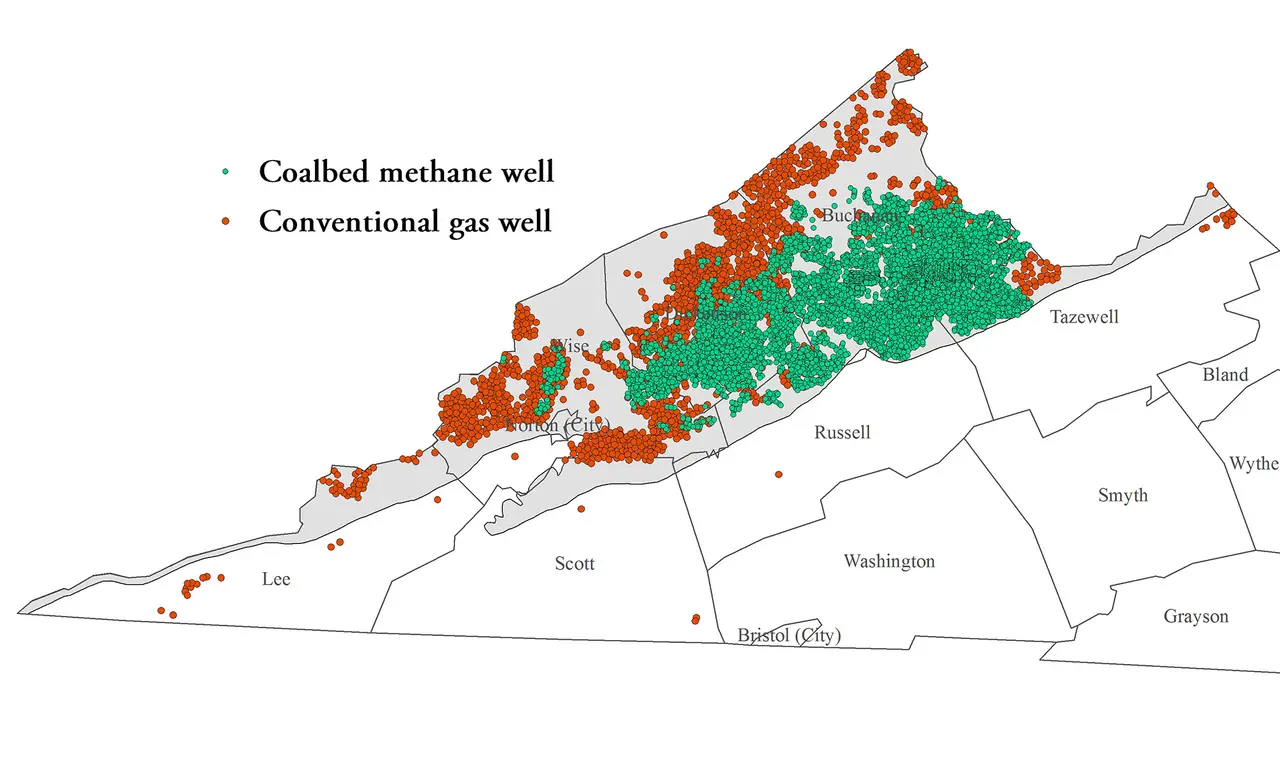
Who owns gas that lives in the coal
Most mineral deeds here were written in the 1880s, long before anyone sold methane out of a coal seam, so they say who owns the coal and say nothing about the gas. Virginia's Supreme Court settled the core question in 2004 in Harrison-Wyatt v. Ratliff, a case from Buchanan County Circuit Court over three 1887 deeds conveying "all the coal in, upon, and underlying" the tracts. The court held that a grant of the coal did not carry the coalbed methane with it, so the gas stayed with the owners who kept the other minerals [212].
Drilling didn't wait for that answer. The 1990 Virginia Gas and Oil Act lets the Virginia Gas and Oil Board force-pool every owner in a drilling unit, so one holdout can't block a well, with unleased owners getting a one-eighth royalty. When the coal owner and the gas owner both claim the methane, the law sends that share into an escrow account held for them, paid out only after a court ruling, arbitration or an agreement between the claimants [213][215]. In 2015 the General Assembly tipped the balance: royalties on conflicting claims are now paid to the gas claimant unless the coal claimant shows a court proceeding or agreement, and owners in units pooled before July 1, 2015 had until Jan. 1, 2016 to apply for release of their money [214].
Where the money got stuck
In 2009 the Bristol Herald Courier reported that the board's escrow held about $24.9 million in 766 active accounts, and the state's gas division estimated that 83% of it was tied to coalbed methane ownership disputes. After the paper's reporting, $825,000 was deposited that same month from operators who hadn't been paying in [216][217]. PolitiFact later tracked a campaign promise to pay it out and found about $9.1 million had been disbursed, with about $20 million still held, and a state official explaining that "in most cases, we can't find the gas owner" [218].
Landowners also went to federal court. The Western District of Virginia certified class actions including Hale v. CNX Gas and Adair v. EQT Production over royalties, involving about $30 million in escrow [219][220]. A $4 million CNX settlement covering more than 1,000 class members in Buchanan, Russell and Tazewell was approved Aug. 24, 2018 [221].
The newest change is about owners nobody can find. In November 2019 the Virginia Treasury told the board to release all money held for unknown or unlocatable owners to the state's unclaimed property division, and operators have since been told to send those royalties directly to Treasury. A 2025 regulation, effective July 17, 2025, wrote that practice into the board's rules [211]. So money owed to a missing heir from a Buchanan gas unit may now sit in the state's unclaimed property search rather than the board's escrow [228].
The fight above the Oakwood longwall
In January 2025, Diversified Energy of Birmingham, Alabama announced it was buying Summit Natural Resources' gas assets for about $45 million, including 300 net producing wells in Virginia and West Virginia that made up about 60% of the deal's production [222]; it closed in February 2025 [223]. On Aug. 19, 2025, the board temporarily transferred operatorship of the acquired units from Summit Appalachia Operating Company to Diversified Production LLC, according to the board's public notice [224]. This is the same company behind the Twin Valley fuel cell proposal in the base sections.
Meanwhile Pocahontas Gas LLC of Cedar Bluff has been pooling units in the Oakwood Coalbed Methane Gas Field II for gob wells, which pull methane out of the broken rock left behind a longwall. Its 2025 filing for unit F-37 estimates the ultimate recovery from Coronado's longwall panel 18 East at 5 to 13 billion cubic feet and from 19 East at 5 to 12 billion, and says an existing well in the unit must be plugged to make way for the longwall [225]. Its G-38 filing describes a set of agreements among Coronado, Appalachian Energy, Henderson Energy, Diversified, Pocahontas Gas and CNX that require wells to be plugged to accommodate mining [226], and the G-39 unit was re-pooled the same month [227].
That's where it turned into a dispute. The board's Sept. 15, 2026 hearing in Lebanon listed appeals by Diversified Production and by Buchanan Energy Company LLC against the director's approval of Pocahontas Gas permits for wells CBM F37A, G37B and G37C in the Garden Magisterial District, continued from July. Pocahontas Gas filed its own petition on the E37 unit asking the board, among other things, to reconsider "its decision to appoint multiple designated operators in the same long wall panel," to settle the two companies' working interests in Panel 20, and to "specially address the payment of production royalties to owners in units where the payor is not the designated unit operator." The same agenda included a new sealed gob unit for Buchanan No. 1's South 2 panel [229]. The next hearing was set for Oct. 20; I couldn't find a published ruling on the appeals.
Gob gas exists because the longwall exists, so coal and gas are tied together on the same panels: mining dictates which wells get plugged and when, and the gas companies fight over who gets to drill into the void the mine leaves. When two operators share one longwall panel, the practical question for a small owner is the one Pocahontas Gas put in its petition, which company actually pays you, and whether the acreage and decimal interest each one uses match. Errors there are how royalty money ends up late, short or in escrow.
For county politics, two threads connect. A supervisor works for Diversified, which is a party to these board fights and the applicant for Twin Valley, so his role is worth watching on any county vote touching Diversified, though the Gas and Oil Board itself is a state body. And coalbed methane output fell about a quarter in four years, which squeezes the gas tax money the county uses for roads just as the 2027 General Assembly decides whether to extend the gas road tax. Practical tip for anyone whose family owned land in a gas unit: search the state's unclaimed property site under every family name, and ask the board's Lebanon office about escrow accounts.
Virginia Energy publishes two different 2025 production figures, 74.9 and 79.8 billion cubic feet, because its gas page and year-end report count differently. The $24.9 million escrow figure is from 2009; I couldn't find a current published total. And Diversified's coal-mine-methane credit wells in that 2025 deal are in Alabama; the Virginia and West Virginia wells were conventional producing wells in its existing footprint, by its own description.
3Dig deeper: every source
Every bracketed number above links to its source. Here they all are in one place. If one doesn't say what we said, tell us.
- energy.virginia.gov/geology/NaturalGas.shtml
- energy.es.virginia.gov/public/documents/Index/Year%20End%20Report%202025%20FINAL%201_final
- register.dls.virginia.gov/details.aspx?id=11656
- www.eia.gov/dnav/ng/ng_sum_lsum_dcu_sva_a.htm
- www.vacourts.gov/static/opinions/opnscvwp/1030634.pdf
- law.lis.virginia.gov/vacode/title45.2/chapter16/section45.2-1622/
- www.energy.virginia.gov/gas-oil/gasoil.shtml
- law.lis.virginia.gov/vacode/title45.2/chapter16/section45.2-1624/
- heraldcourier.com/news/money-made-from-southwest-va-gas-wells-isn-t-reaching/article_52564
- virginianreview.com/26967/
- www.politifact.com/virginia/promises/macker-meter/promise/1162/pay-out-gas-royalties-lando
- naturalgasintel.com/news/federal-judge-certifies-three-of-five-virginia-royalty-cases-as-c
- www.vawd.uscourts.gov/OPINIONS/SARGENT/110cv37rar.pdf
- valawyersweekly.com/2018/09/07/settlement-approved-in-sw-va-gas-royalties-suit/
- www.vamoneysearch.gov/
- ir.div.energy/news-events/us-press-releases/detail/185/diversified-energy-announces-strate
- ir.div.energy/news-events/us-press-releases/detail/190/diversified-closes-summit-natural-r
- wvlegals.com/public-notice-29105/
- www.energy.virginia.gov/DgoBoard/Dockets/2025-08/09_PGLLC_25-0715-4312.pdf
- www.energy.virginia.gov/DgoBoard/Dockets/2025-08/07_PGLLC_25-0617-4308.pdf
- www.energy.virginia.gov/DgoBoard/Dockets/2025-08/06_PGLLC_06-0221-1577-02.pdf
- energy.virginia.gov/DgoInquiry/frmmain.aspx?ctl=68
Was this useful?
Send feedback. One question, no name needed. Report a correction.