
The river, the pipes, and who runs them
1The short version
Every big project in this county, from the new high school to the four-lane 460, is partly a flood story. The Levisa Fork and creeks like Knox Creek and Slate Creek have shaped where people can live and build for a century, and the February 2025 flood showed the job isn't finished. The quieter half of the story is the water and sewer system, which the flood tore up and which is still being repaired almost two years later.
Got the gist? Keep going for the full story, or share this with someone who should know.
2The full story

February 2025: the flood that still isn't paid off
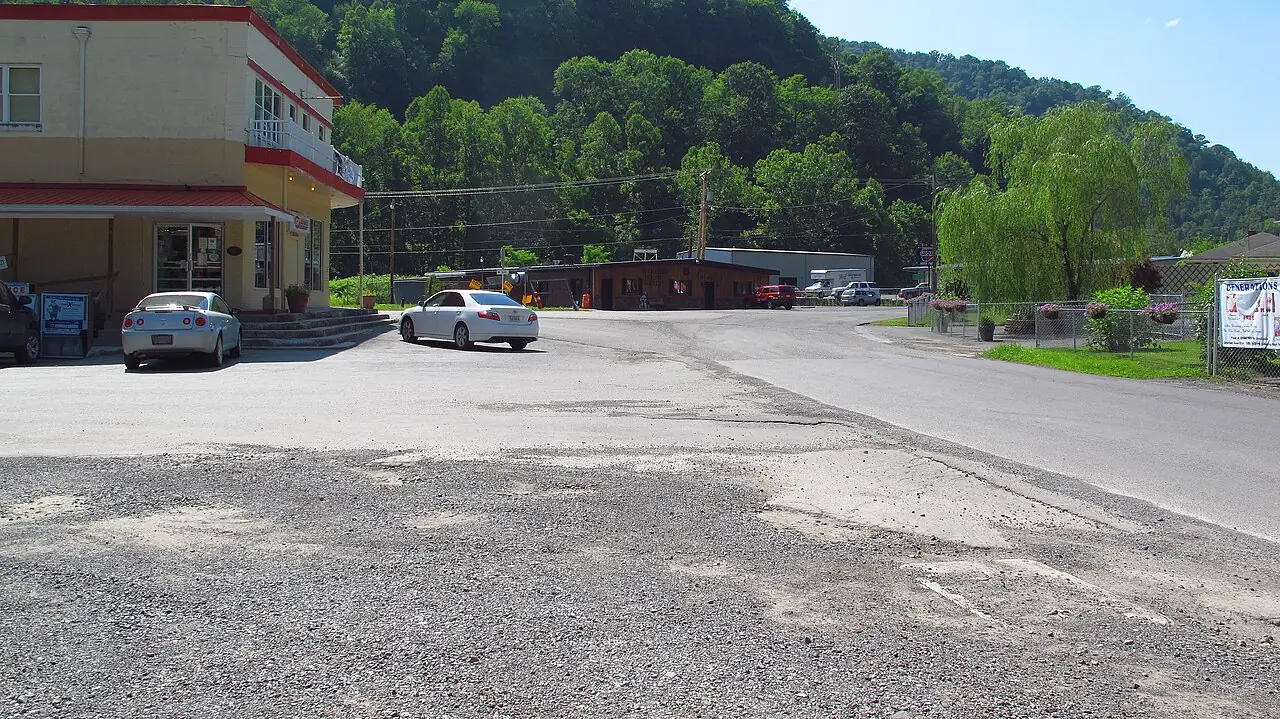
Over the weekend of Feb. 15 and 16, 2025, days of rain, up to 7 inches in places, fell on ground already soaked by a week of rain, snow, and ice, and sent rivers across Southwest Virginia to high crests. More than 150 swift-water rescues were made region-wide. The hardest-hit places were Hurley, Slate Creek, and the town of Grundy[57]. Cardinal News counted it as the fourth major flood in the region since the summer of 2021, after Guesses Fork near Hurley in August 2021, Whitewood in July 2022, and Hurricane Helene's remnants in September 2024[59].
Buchanan took the worst of it. Joint state and federal damage assessments found 18 homes destroyed across the region, and 17 of them were in Buchanan County. The county also had 26 homes with major damage, 60 with minor damage, and 103 more affected[57]. In Hurley, Knox Creek rose into the town center, power went out, and the main water line was damaged. Hurley Elementary/Middle School ran as a shelter, and the National Guard brought food and water to people cut off when private bridges over the creek washed out[58]. Supervisor Trey Adkins, who represents Hurley, answered a question about how bad it was with one word: "Very"[59].
The federal money is arriving in small checks. This year FEMA's Public Assistance program has approved, for Buchanan, $163,925 for asphalt road repair[67], $389,310 for debris removal[66], $310,799 for embankments, culverts, gabion stone, and riprap[65], and more than $200,000 for culverts[64]. That's a bit over $1 million, arriving 16 to 20 months after the water went down, and it reimburses the county for work it largely had to front. Households can still apply to the state's $50 million Virginia Disaster Assistance Fund for total loss or major damage from Helene or the February 2025 storms, through the Cumberland Plateau Planning District Commission at (276) 880-4020 or recovery@cppdc.org, first come, first served until the money runs out[68].
The sewer line in the river
On Feb. 15, 2025, the flood broke sewer lines, knocked manholes out of place, and packed pipes with rock and gravel, so sewage leaked into Slate Creek and the Levisa Fork, and the health district issued a recreation advisory for both[60]. By February 2026 the county Public Service Authority (PSA, the county water and sewer utility) had fixed everything except one stretch lying in a deep section of the Levisa near Norfolk Southern's Weller Yard. Hill Construction of Clintwood won that job in February 2026, with a target finish of Feb. 26, 2027[60]. That's two full years from flood to final repair.
Cash flow is the hidden problem. In June, the PSA needed help paying a $1 million Hill Construction bill because state DEQ reimbursement hadn't come in yet, so supervisors gave the authority its full $3.2 million annual county funding in one payment instead of six monthly installments[61]. That's the pattern for small utilities after disasters: the state and federal money is real but slow, and the local agency has to float the cost in between.

What's in the tap, and what it costs
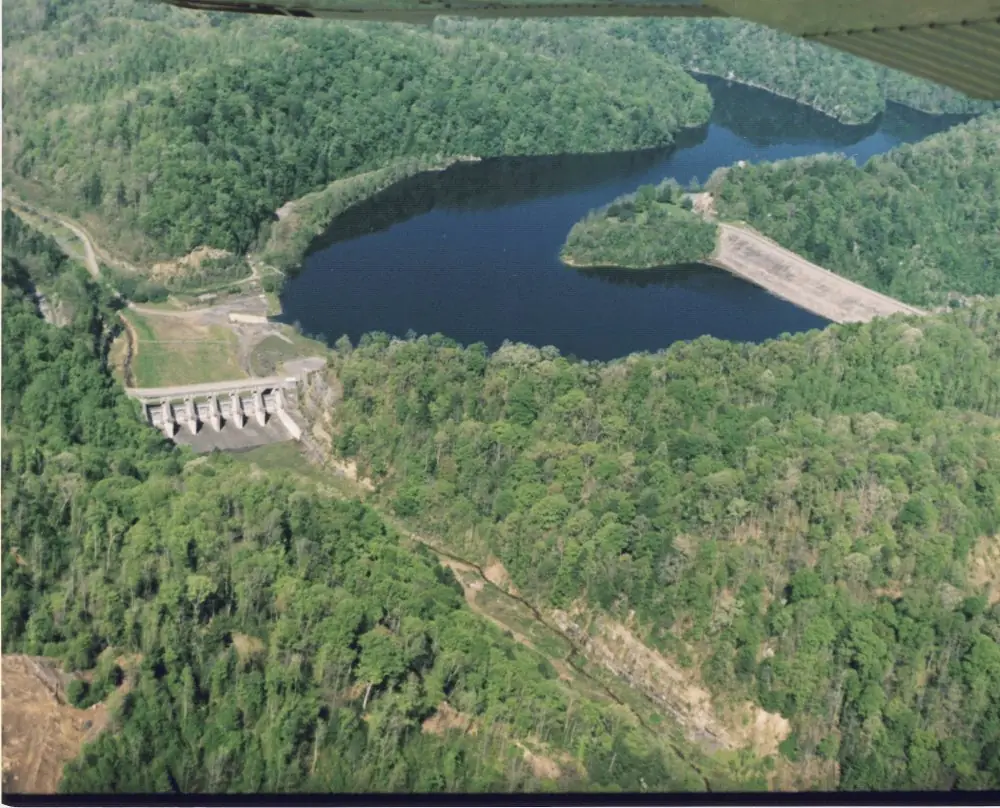
The PSA's main system runs on treated surface water, drawing from the John Flannagan Water Authority intake and the Kennel Gap wells. A state assessment rated both sources highly susceptible to contamination, which is typical for surface water in mining and gas country. Its 2025 water-quality report shows no violations. Disinfection byproducts, the chemicals that form when chlorine meets organic matter, came in under the limits but not by a wide margin: haloacetic acids at 42 against a limit of 60, and total trihalomethanes at 57 against 80, with single samples as high as 52 and 74[70].
Lead is mostly an unknown. The PSA's federally required inventory found 2 lead and 5 galvanized service lines that need replacing, and 7,264 lines of unknown material. Lead itself wasn't detected in 2025 tap sampling[70]. The honest read is that the utility doesn't yet know what most of its service lines are made of, which is common nationally but is the next federal mandate it will have to pay for.
Rates. A standard residential bill is $26.01 a month for the first 1,000 gallons, then $9.00 per 1,000 gallons after that, plus a $1 infrastructure fee on every account. New water or sewer connections cost $750 each, and the PSA still runs a water truck at $31.21 per delivery for homes off the lines[69]. As an illustration, a household using 4,000 gallons a month would pay about $54 for water alone before any sewer charge. That $9 per 1,000 gallons is steep next to many larger utilities, and it reflects a lot of pipe across hard terrain serving relatively few customers.
Projects in the pipeline. The PSA is replacing about 14,100 feet of worn-out waterline along Route 619 in Leemaster, where frequent breaks hit roughly 90 households, through the state's water-supply revolving fund[63]. It has asked for $2 million for a Conaway wastewater project, finished the Dry Fork project with federal pandemic-relief money, and was turned down this year for a backup generator grant[62]. Crews are also chasing sewer problems in Garden Creek and Looney's Creek[62].
Who runs the utility
This is worth knowing before any conversation about water bills or flood repair. Tim Hess, chairman of the Board of Supervisors, is also the PSA's executive director, and Supervisor David Rose is also employed by the PSA. Both abstained when supervisors voted on PSA funding in June, which passed 5-0-2[61]. Supervisors Jeff Cooper and Lee Dotson also sit on the PSA's own board[62]. So four of the seven supervisors have a formal tie to the utility the county funds with $3.2 million a year.

The 50-year flood fix: moving Grundy, then the schools
Grundy moved across the river. In April 1977, about 16 inches of rain fell upstream in a day, putting nearly 6 feet of water in downtown Grundy, killing three people, and causing about $15 million in damage[71]. The town had flooded before, in 1937 and 1957 too[73]. Congress named Grundy for a federal flood-control study in 1981, but under the 1986 water-projects law the town had to cover 25% of the cost, and it couldn't raise that money[72]. The fix was a deal pairing the Army Corps with VDOT's planned widening of Route 460: the state bought and tore down most of the old business district, the land purchase counted as the local match, and the new highway was built on a levee that doubles as a floodwall[72]. The Corps sheared off a mountainside to make flat ground across the river for a new town center, which ended up anchored by a three-story Walmart[73]. The Corps finished its floodwall in 2008, and the highway was completed in 2023[72][73]. Tass Robertson, speaking to Radio IQ about how long it all took, put it this way: "I was two years old when the flood hit, and I'm 49 now"[73].
The rest of the county got a buyout and home-raising program. Outside Grundy, the same Section 202 law funds a voluntary program for structures in the county that flooded in April 1977: the Corps either raises a home above the 1977 or 100-year flood level, whichever is higher, or buys and demolishes it if it can't be raised safely[74]. The 2005 agreement estimated about 730 eligible structures, 319 for raising and 411 for buyout, at a projected total cost of $118.6 million[76]. The application window closed Jan. 16, 2023, after being reopened for six months following the July 2022 flood[74].
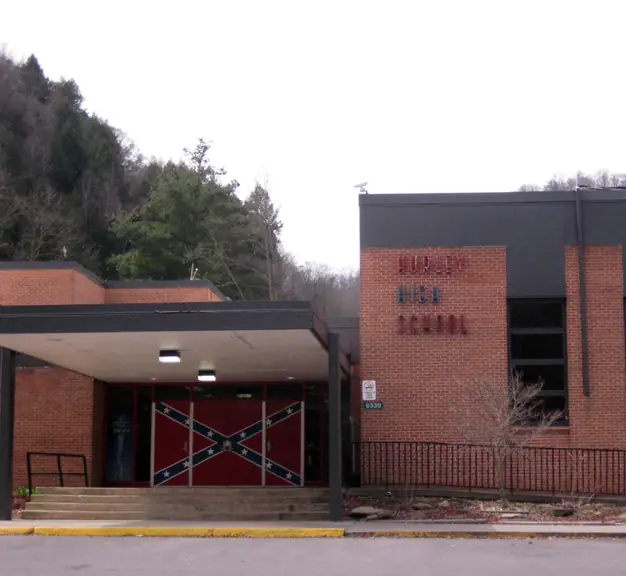
Southern Gap High is a flood project too. The Corps found that moving Hurley High School out of the floodplain was the cheapest workable fix, while the career center qualified for a protective ringwall. In January 2021 the school board proposed combining both on one new campus at Southern Gap, and Warner, Kaine, and Griffith pressed the Corps to finalize the agreement[75][74]. So the consolidated high school covered earlier in this briefing was driven by both population loss and the floodplain.
3Dig deeper: every source
Every bracketed number above links to its source. Here they all are in one place. If one doesn't say what we said, tell us.
- commons.wikimedia.org/wiki/File:Hurley,_Virginia.jpg
- cardinalnews.org/2025/03/05/90-homes-sustained-major-damage-and-18-were-destroyed-in-febru
- cardinalnews.org/2025/02/17/weekend-deluge-leaves-destroyed-homes-washed-out-roads-and-at-
- cardinalnews.org/2025/02/18/as-floodwaters-recede-hurley-residents-begin-the-long-cleanup/
- morgangriffith.house.gov/news/documentsingle.aspx?DocumentID=405724
- wcyb.com/news/local/buchanan-county-gets-389310-in-fema-aid-for-debris-removal-after-2025-
- morgangriffith.house.gov/news/documentsingle.aspx?DocumentID=405814
- virginiamountaineer.com/2026/10/07/fema-approves-more-than-200000-for-county-culvert-repai
- www.dhcd.virginia.gov/disaster-assistance
- www.deq.virginia.gov/news-info/shortcuts/topics-of-interest/buchanan-county-sewer-infrastr
- virginiamountaineer.com/2026/06/17/bos-approves-bcps-psa-funding-for-fiscal-year-2026-27/
- commons.wikimedia.org/wiki/File:John_W_Flannagon_Dam.jpg
- buchanancountypsa.myruralwater.com/documents/556/PWSID_102061_MAIN_2025_CCR.pdf
- buchanancountypsa.myruralwater.com/rates-and-policies
- virginiamountaineer.com/2026/09/09/approval-of-a-categorical-exclusion-from-an-environment
- virginiamountaineer.com/2026/09/16/psa-advances-water-sewer-and-office-projects-2026-09-17
- virginiamountaineer.com/2026/10/28/energy-proposal-could-bring-jobs-new-use-to-former-twin
- commons.wikimedia.org/wiki/File:HurleyHighSchool.jpg
- appvoices.org/2002/06/01/2911/
- www.wvtf.org/news/2025-01-09/after-flooding-in-1977-the-army-corps-tore-down-most-of-downt
- www.virginiaplaces.org/vacount/grundy.html
- www.lrd.usace.army.mil/Missions/Projects/Article/3631343/buchanan-county-section-202-proje
- usace.contentdm.oclc.org/digital/api/collection/p16021coll7/id/1775/download
- www.warner.senate.gov/newsroom/press-releases/warner-kaine-griffith-urge-swift-action-on-b
Was this useful?
Send feedback. One question, no name needed. Report a correction.